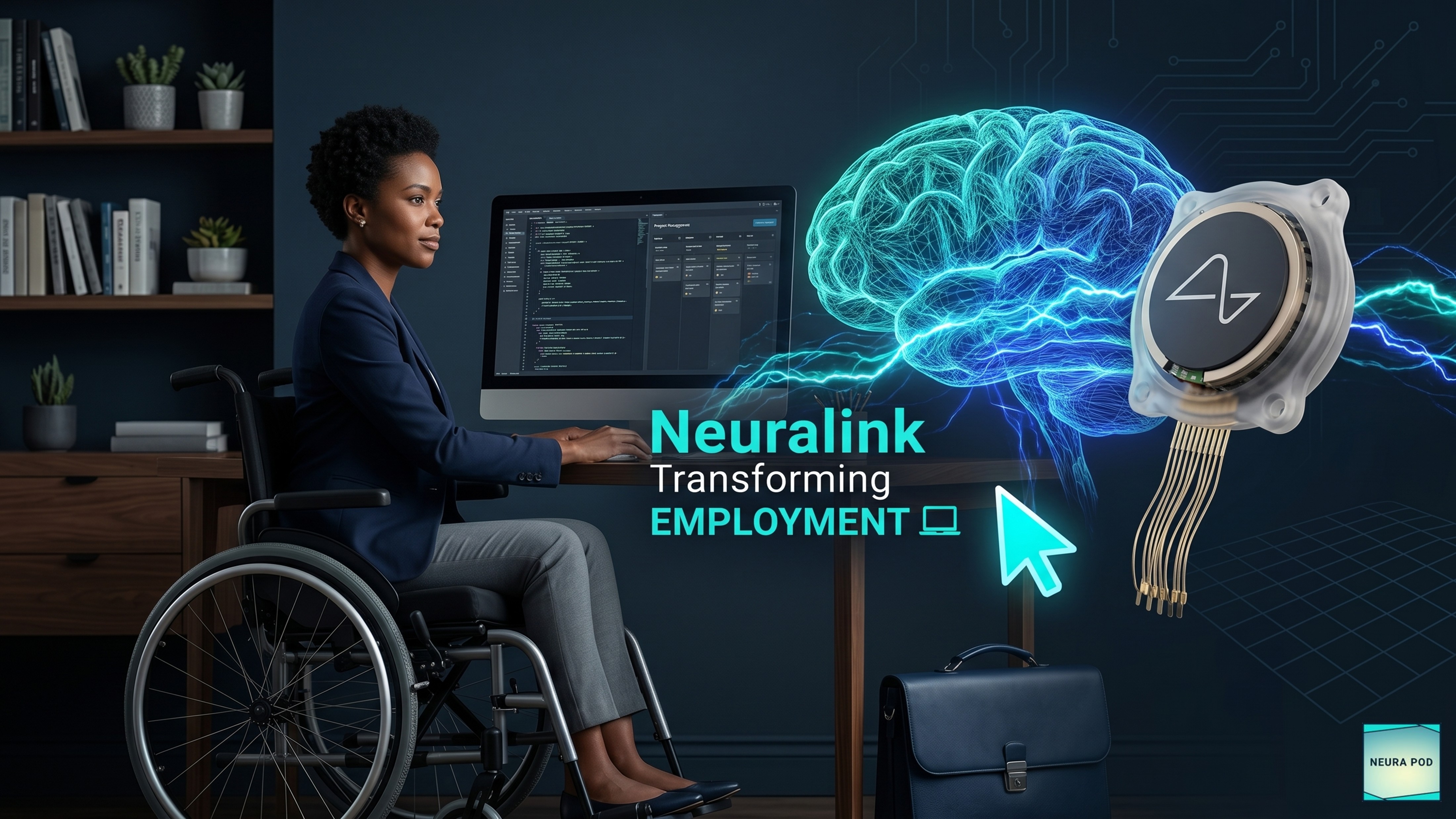
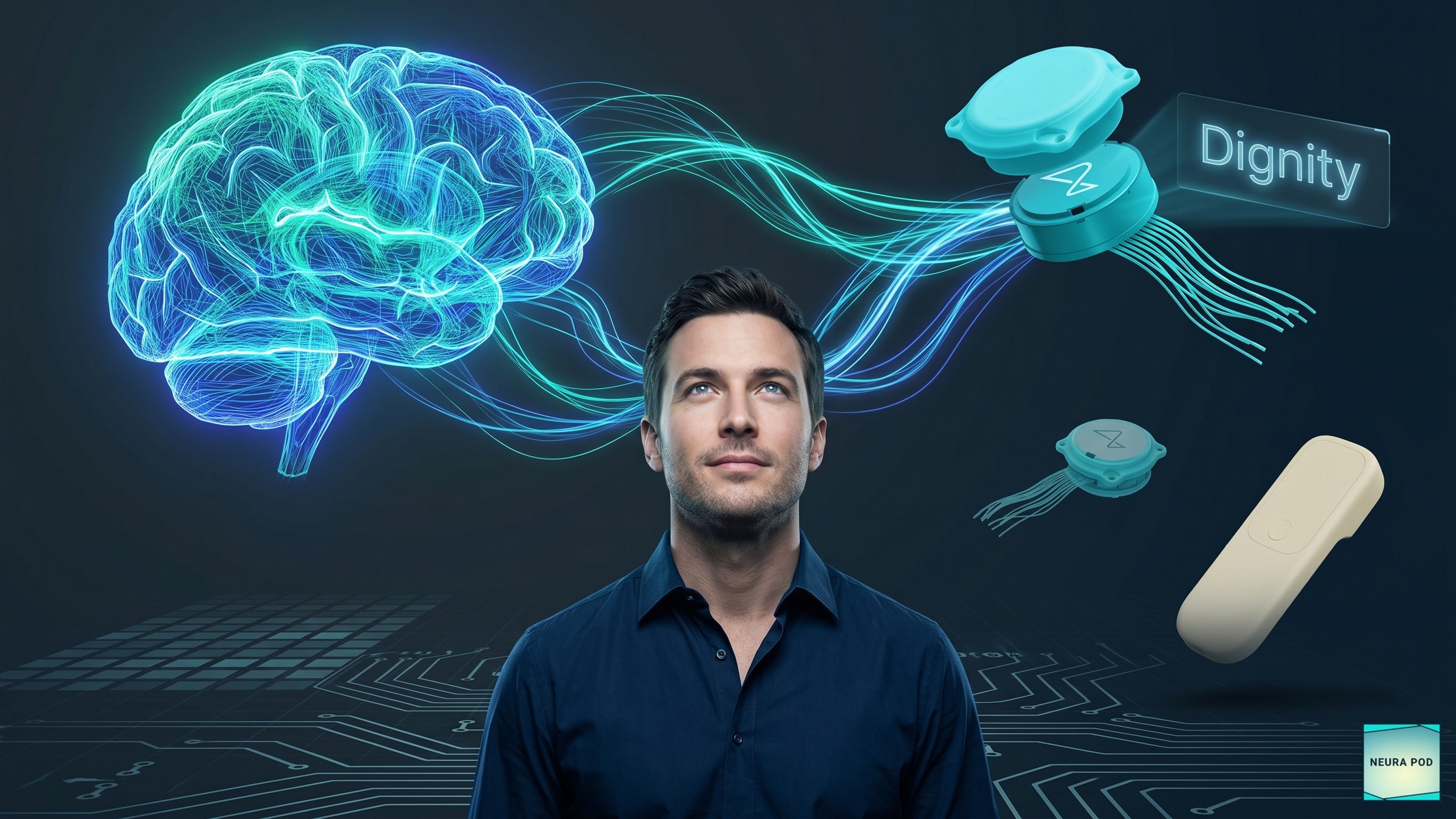
- Assistive technology is often marketed on convenience: faster typing, better accuracy, less setup. But the variable that actually matters to patients is dignity.
- Dignity after paralysis is defined by the ability to act as a whole person, not as someone waiting for someone else to act on their behalf.
- Neuralink's early patients consistently describe the implant in terms of dignity restored, not merely function gained: a distinction that matters for how the technology should be understood and valued.
The Wrong Frame: "Convenience"
Most news coverage of brain-computer interfaces frames them the same way consumer tech gets framed: a list of specifications, speed benchmarks, and productivity gains. Words per minute. Cursor accuracy. Number of apps supported. That framing is not wrong, but it misses the entire reason the device exists.
Paralyzed people already have adaptive options. Eye-gaze keyboards, mouth sticks, sip-and-puff controllers, head-tracking software. All of them provide some level of function. Anyone can measure the raw speed delta between a mouth stick and a Neuralink. But speed is not the point for most patients. The point is being able to do something without visibly depending on someone else to do it for you.
What Dignity Actually Means in This Context
Dignity, in the clinical rehabilitation literature, tracks to three concrete things: autonomy of action, privacy, and social visibility as a full adult. Paralysis attacks all three simultaneously.
Autonomy of action disappears because nearly every task requires either a caregiver or a modified interface that is slower, more public, and more fatiguing than baseline.
Privacy disappears because the daily infrastructure of paralysis (caregivers in the home, shared computers, voice-spelled text) collapses the boundary between what you think and what someone else has to hear and type.
Social visibility as a full adult disappears because the default public perception of a person in a wheelchair, unable to speak or gesture conventionally, is still paternalistic. Strangers talk past the patient to the caregiver. Medical staff default to the family member in the room. Companies default to "who pays" rather than "who uses."
Why a Neuralink Changes This
A brain-computer interface, specifically one that reads intent directly from the cortex with no intermediate visible movement, changes this on every axis.
It restores autonomy of action because the patient initiates, executes, and completes the task themselves. No caregiver transcribes. No device draws attention to the effort. No one else has to be in the room.
It restores privacy because the conversation, message, or work product moves from idea to screen without a human intermediary. For the first time since their injury, a patient can write a message to their partner, their child, or their doctor without someone else seeing it first.
It restores social visibility because in a meeting, a classroom, or a family dinner, the patient's typed words or synthesized voice arrive at the same conversational tempo as everyone else's: not minutes later, not mediated by a helper, not preceded by "let me get that for them."
What Patients Actually Say
This distinction of dignity over convenience shows up unmistakably in patient testimony. Noland Arbaugh, the first PRIME study participant, has spoken repeatedly about the shift from waking up with no reason to get out of bed to waking up excited:
Jake Schneider, an ALS patient in the VOICE trial, captured the dignity framing more directly when he described sharing a video with his son:
Neither patient frames the implant primarily as a speed improvement. Both frame it as a recovery of identity — of being able to show up to their own lives as themselves.
The Caregiver Angle
Dignity matters for caregivers too. Families of paralyzed people often describe the strangest form of grief: watching someone they love still be physically present but unable to participate in the small adult rituals that signal full personhood: sending a private message, writing a note, choosing their own words in the moment. A Neuralink recipient can do all of those things independently, which rebalances the relationship from caregiving toward the ordinary rhythm of being related to someone as an adult.
That rebalance is not just emotionally significant. It's one of the strongest predictors of long-term relationship stability after a catastrophic injury.
Why This Matters for How We Measure the Technology
If we measure Neuralink only on performance metrics (words per minute, selection accuracy, application compatibility) we will consistently understate what the device actually does. A better measurement framework asks:
- Does the patient act independently, without caregiver mediation, for a meaningful portion of the day?
- Does the patient initiate communication, rather than only respond to it?
- Does the patient's family perceive them as more themselves than before the implant?
- Does the patient describe their daily life in terms of purpose and contribution, rather than waiting and care?
Those are dignity metrics, and they are where the early PRIME and VOICE data is most striking, regardless of whether the typing speed eventually reaches or exceeds able-bodied baselines.
Beyond Paralysis
The same frame applies to Neuralink's other product lines. A Blindsight recipient who begins to perceive light and shape after years of total blindness isn't primarily gaining image resolution — they're regaining the social visibility of a person who can navigate a room unassisted. An ALS patient regaining their own voice via speech restoration isn't gaining a feature; they're recovering the identity of being able to speak as themselves.
In every case, convenience is downstream. Dignity is the primary product.
Summary
Assistive technology is too often evaluated on convenience. For the people who use it, the decisive variable is dignity. The ability to participate in one's own life as a full adult, with autonomy of action, privacy, and full social visibility is of utmost importance. Neuralink's early patients frame their implants in exactly those terms, repeatedly and across injury types.
That framing matters because it shapes what we expect from the next decade of brain-computer interfaces. If we understand Neuralink as a dignity-restoration technology first and a productivity technology second, the case for scaling it to millions of people becomes harder to dismiss, and the case for funding, regulation, and access reform becomes easier to make.