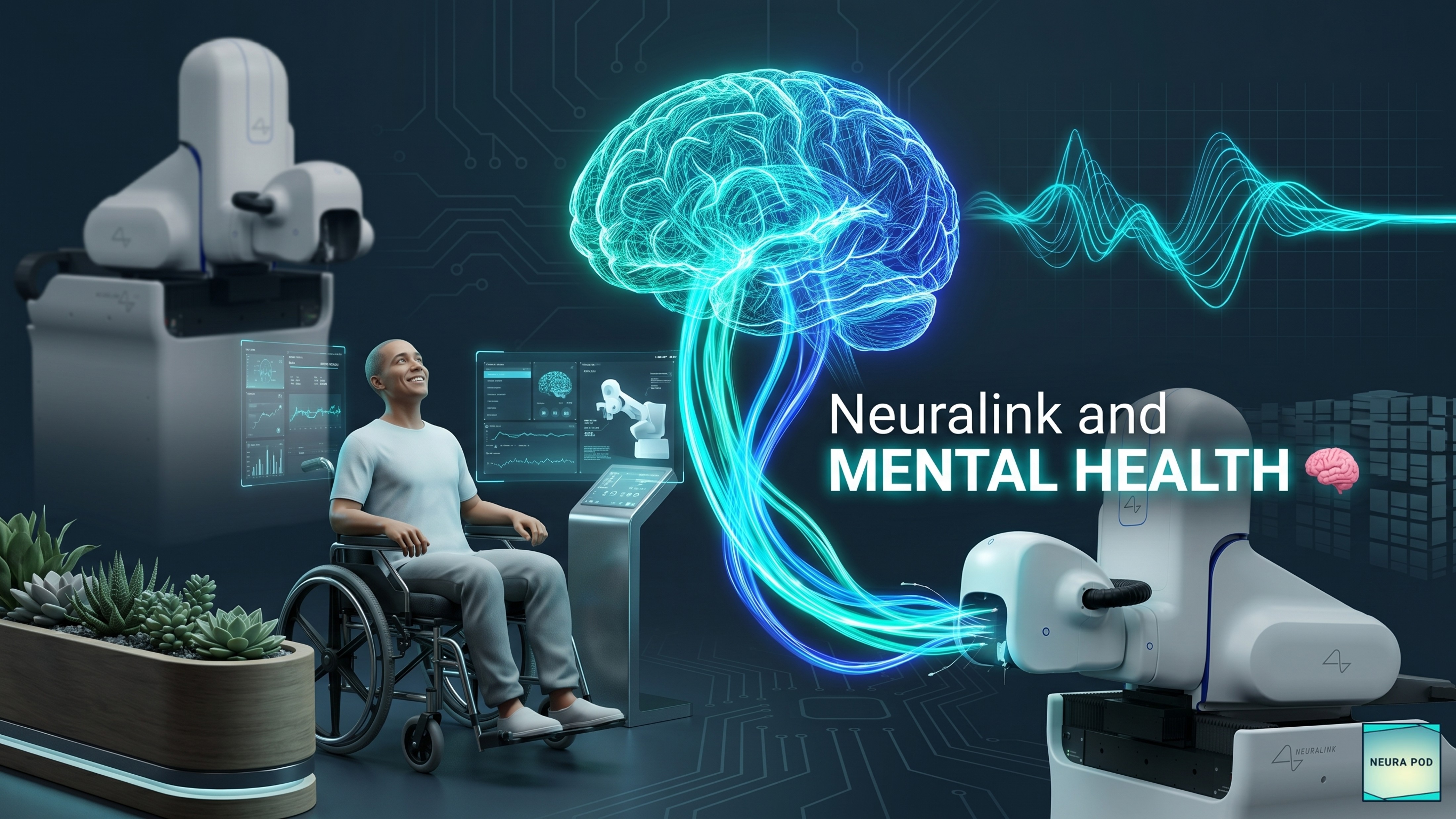
- Depression affects roughly 19–26% of people with spinal cord injury (about 3x the rate in the general population) and suicide rates among SCI patients run nearly five times higher than expected.
- The dominant cause isn't the physical injury alone - it's the sudden loss of autonomy, purpose, and perceived self-worth that follows.
- Early Neuralink patients describe the restoration of autonomy as directly reversing depressive patterns: sleep rhythms, motivation, and a sense of purpose returning in parallel with implant use.
The Mental Health Cost of Paralysis
Paralysis is almost always accompanied by a second, quieter injury: the collapse of day-to-day autonomy. Rates of clinical depression among people with spinal cord injury run between 19% and 26% (roughly three times higher than the general population), and some studies put the figure as high as 49% depending on the population sampled. Suicidal ideation is 2.3 times more common than baseline, and the completed suicide rate among SCI patients is close to five times the expected rate, with risk peaking in the first five years after injury.
The causes are well understood, even if the solutions aren't. Depression after paralysis tracks closely with three things: the inability to work or contribute, the feeling of being a burden on loved ones, and the loss of small, daily sources of agency: typing, messaging, browsing, setting a schedule. Traditional rehabilitation addresses physical mobility and some functional adaptations, but it rarely gives back the specific daily-autonomy layer most tightly linked to mental health outcomes.
Why Autonomy Matters So Much
Psychiatric literature on post-injury depression consistently points to perceived agency as a central predictor of recovery. Patients who retain some meaningful form of daily control — over communication, work, relationships, or creative output - are far less likely to develop chronic depression than those whose days become structured entirely around assisted care.
That's what makes a brain-computer interface meaningfully different from adaptive peripherals. A mouth stick or eye-gaze keyboard gives back some control, but at the cost of fatigue and visible effort. A Neuralink implant, by contrast, restores the invisible layer: thinking about an action and having the computer respond instantly, with no intermediate device to battle.
What Early Patients Are Describing
The most direct evidence comes from patients themselves. Noland Arbaugh, the first PRIME study participant, has been unusually candid about the psychological shift that followed his implant:
Noland has separately described the deeper emotional weight that accompanies a high cervical injury. He also shares how an implant can challenge it:
The framing that the paralysis itself is not the primary wound but the sense of being a burden is, appears repeatedly in patient testimony across the PRIME and VOICE programs. And it points directly to why a Neuralink can function as something like a clinical antidepressant, even though that's not how the device is formally classified.
Jon Noble: A Second Voice on the Same Pattern
Patient 7, Jon Noble (@CheckCanopy), has described a nearly identical psychological arc:
When multiple independent patients in different injury types describe the same pattern: sleep normalizing, morning motivation returning, a sense of purpose reappearing - it stops being a one-off and starts looking like a reproducible psychological response to restored autonomy.
Beyond Anecdote: Why This Is Plausibly Clinical
None of this proves Neuralink treats depression in a regulatory sense. Formal clinical trials measuring psychiatric outcomes will take years. But the mechanism is straightforward and well-supported by existing SCI psychology literature:
- Restored daily autonomy reduces perceived burden on caregivers.
- Reduced caregiver burden eases shame, which is a major contributor to post-injury depression.
- The ability to produce output (messages, work product, creative work), reestablishes identity and purpose.
- Purpose and agency are the two strongest buffers against suicidal ideation in the SCI literature.
A device that restores all four, simultaneously and continuously, is hard to compare to any prior intervention in SCI care.
The VOICE Trial and ALS-Linked Depression
The psychological picture in ALS is similar but carries a sharper time pressure. Patients typically lose speech progressively and know it's coming. That foreknowledge is itself a major driver of late-stage ALS depression. The VOICE trial is beginning to show that restoring a patient's ability to communicate in real time (sometimes in their own pre-ALS voice) can reverse some of that anticipatory grief. Brad Smith, Kenneth Shock, and Nick Wray have all spoken publicly about how meaningful the reopened communication has been for their mental state, not just their practical function.
Limits and Realistic Expectations
Restored autonomy does not cure clinical depression on its own. Patients with severe pre-existing depression, complex trauma histories, or other mental health conditions will likely continue to benefit from medication, therapy, and community support. What a Neuralink can do is remove one of the largest structural drivers of post-injury depression (the collapse of daily agency) making those other interventions more effective.
Future Neuralink programs may eventually target depression directly, as Elon Musk has named it among the conditions the device is intended to address. But even without a depression-specific indication, the indirect mental health effects of the current implants are already emerging clearly from patient testimony.
Summary
Depression and suicide risk are dramatically elevated after spinal cord injury and ALS, driven primarily by the loss of autonomy, purpose, and perceived contribution, not by paralysis itself. Neuralink's early patients consistently describe the implant as restoring all three, often within weeks of activation.
For the tens of millions of paralyzed and neurologically impaired people living with elevated depression risk today, a scalable brain-computer interface could become one of the most significant mental health interventions of the next decade- not because it treats depression pharmacologically, but because it removes the underlying condition most responsible for it.