~5 min read
- Roughly 35% of spinal cord injury survivors are employed twenty years post-injury — less than half the rate of the general population.
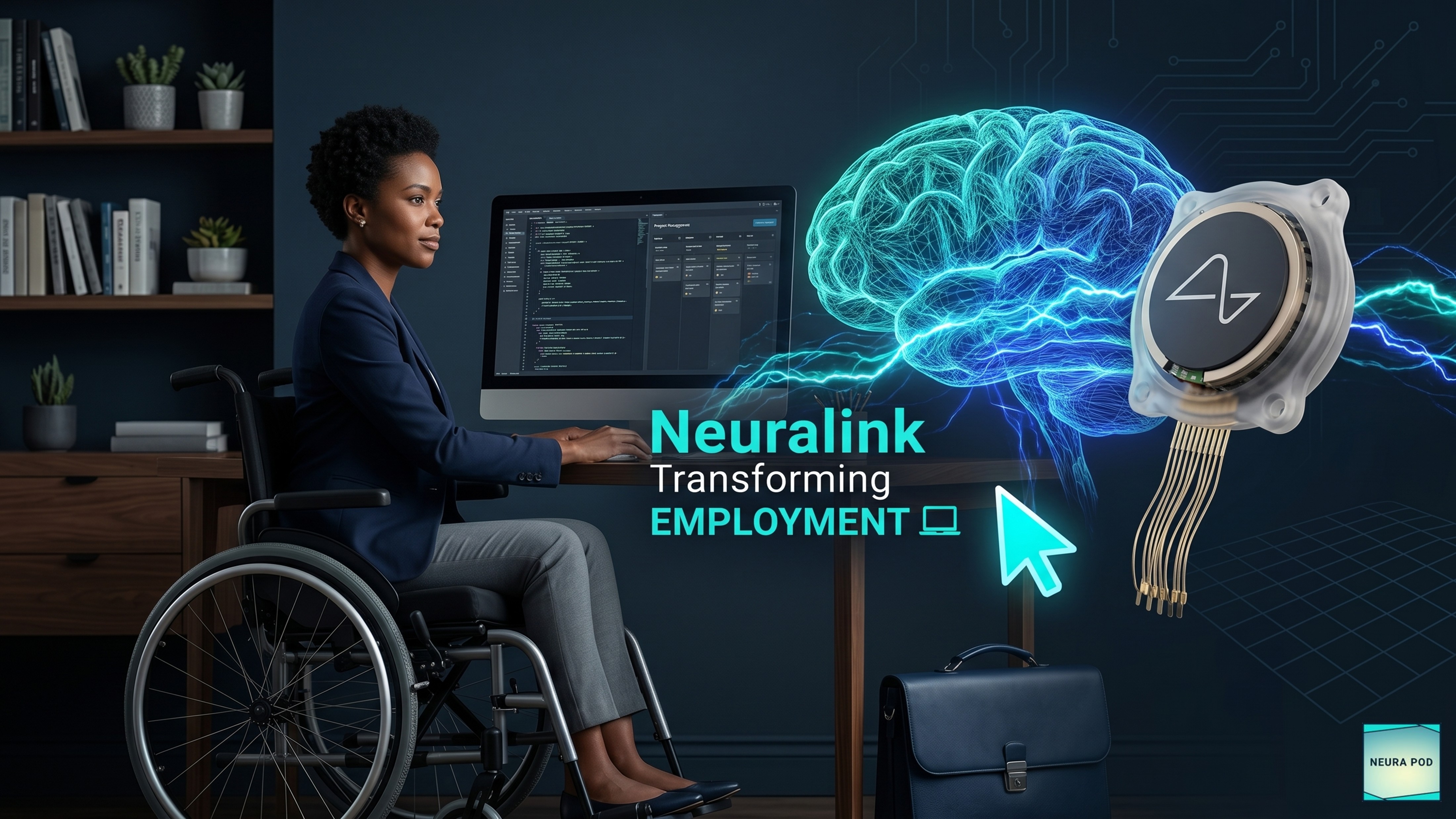
- Neuralink is already letting paralyzed patients return to school, run small workflows, and put in full work days entirely with their minds.
- As the technology scales, return-to-work rates for paralyzed adults could climb dramatically — with economic, psychological, and identity benefits that compound over time.
The Employment Gap After Paralysis
The data on spinal cord injury and employment is sobering. An international survey across 22 countries put the average SCI employment rate at 38%, while US Spinal Cord Injury Model Systems data shows just 35% of SCI patients employed 20 years post-injury. Break that down by severity and it gets starker: roughly 32% of people with paraplegia are employed a decade after injury, compared to only 24% with tetraplegia. Compare those figures to the roughly 70% general US employment rate and the gap is undeniable.
Timing matters, too. The average time from injury to first post-injury job is about 4.9 years, and only 12% of people employed at the time of injury return to the same job. Paralysis doesn't just interrupt careers — it typically ends them, forcing long pivots into entirely new fields, often years after the initial injury.
For those who live with quadriplegia or high-cervical injuries, the barriers compound: physically returning to an office, typing at a normal pace, operating standard workplace software, and managing a commute are all either impossible or exhausting.
What Neuralink Changes
A Neuralink implant targets the single most universal bottleneck in post-paralysis employment — the ability to reliably operate a computer at the speed of thought. The first few dozen PRIME study participants are already demonstrating what that looks like day-to-day, and several have returned to productive work or school as a direct result.
First @Neuralink product will enable someone with paralysis to use a smartphone with their mind faster than someone using thumbs
— Elon Musk (@elonmusk) April 8, 2021
That early prediction has largely come true. Noland Arbaugh, the first PRIME participant, has gone back to college alongside his implant, passing introductory tests at near-perfect scores. His longtime advocate DJ Seo shared the milestone publicly:
Longest Neuralink user, at almost 19 months. Congrats on going back to school, Noland!
— DJ Seo (@djseo) August 15, 2025
Full Work Days With an Implant
Noland's experience is no longer unique. Nick Wray, Patient 8 in the study, has written publicly about putting in multiple consecutive eight-hour work days using his Neuralink:
I can't remember the last time I put in a solid 8 hour work day and last week I put in 3 in a row. It was one of the most incredible experiences of my life so far.
— Nick Wray (@Telepath_8) October 6, 2025
Eight hours of uninterrupted computer use is the functional baseline of modern knowledge work. Word processing, spreadsheet analysis, email, project management, customer support, coding — all of these are workloads a Neuralink user can now realistically sustain, often for longer than pre-injury because the implant removes the fatigue of adaptive input devices like mouth sticks or eye-gaze keyboards.
ALS Patients Writing, Coding, and Publishing Again
The VOICE trial adds another dimension. ALS takes the ability to speak and type away from previously active professionals at the peak of their careers. Brad Smith, Kenneth Shock, and Jake Schneider — all ALS patients using Neuralink — are using their implants not only to communicate but to produce original creative and professional work. Jake, for example, is writing a book using only his thoughts:
I typed every word in this video using only my thoughts. It was made for the Neuralink team.
— Jake (@PairedWith_P7) December 14, 2025
Beyond the Keyboard: Robotic Arms and Full Workstations
Employment isn't only cognitive. For certain roles — lab work, hands-on creative production, physical assistance — a computer alone isn't enough. Neuralink's integration with Optimus and other assistive robotic platforms extends the envelope further. Alex Conley is already controlling a robotic arm with his implant, and the Neuralink team has stated that dual implants — one in the motor cortex, another below the spinal injury — are a priority for the next development cycle.
This is where Neuralink stops being a communication device and becomes an employment enabler in the fullest sense. A quadriplegic patient who can operate a computer and control a robotic assistant is no longer limited to remote knowledge work. They can participate in physical tasks, creative production, and roles that until now were permanently closed.
Why This Matters for Identity, Not Just Income
Employment after paralysis is not only about money. Patients who return to work consistently report higher life satisfaction, lower rates of depression, and a stronger sense of purpose. Patient 1, Noland Arbaugh, has spoken frequently about how having a goal to wake up for fundamentally changed his day-to-day experience. Patient 6, Rob Greiner, described a similar shift — a path back toward contribution and contact with the world rather than a life of waiting.
For millions of paralyzed adults worldwide, the question isn't just "can I earn a paycheck?" — it's "can I still be who I was?" A Neuralink implant, by giving the mind back direct command of digital tools, reopens that question in a way that ramps, modified keyboards, and eye-gaze software never fully could.
Scaling the Effect
Elon Musk has stated that Neuralink's goal for late 2026 is automated surgery and high-volume production, with a waiting list already exceeding 10,000 patients. If even a fraction of the global paralyzed population — roughly 15 million people — receives an implant over the next decade, the macroeconomic effect could be significant. Reversing the SCI employment rate from 35% back toward 60–70% would mean hundreds of thousands of workers returning to productive roles, contributing to tax revenue, consumer spending, and — perhaps most importantly — their own households.
Summary
Paralysis historically ends careers. Neuralink is beginning to rewrite that equation, with dozens of patients already using their implants to return to school, hold down full work days, and produce original creative and professional work. As automated surgery and international trials scale through 2026 and beyond, the employment gap between paralyzed and able-bodied adults could shrink by an order of magnitude.
Return to work is one of the cleanest measures of what a BCI actually does for a life. On that measure, Neuralink's early patients are already providing a hopeful answer.