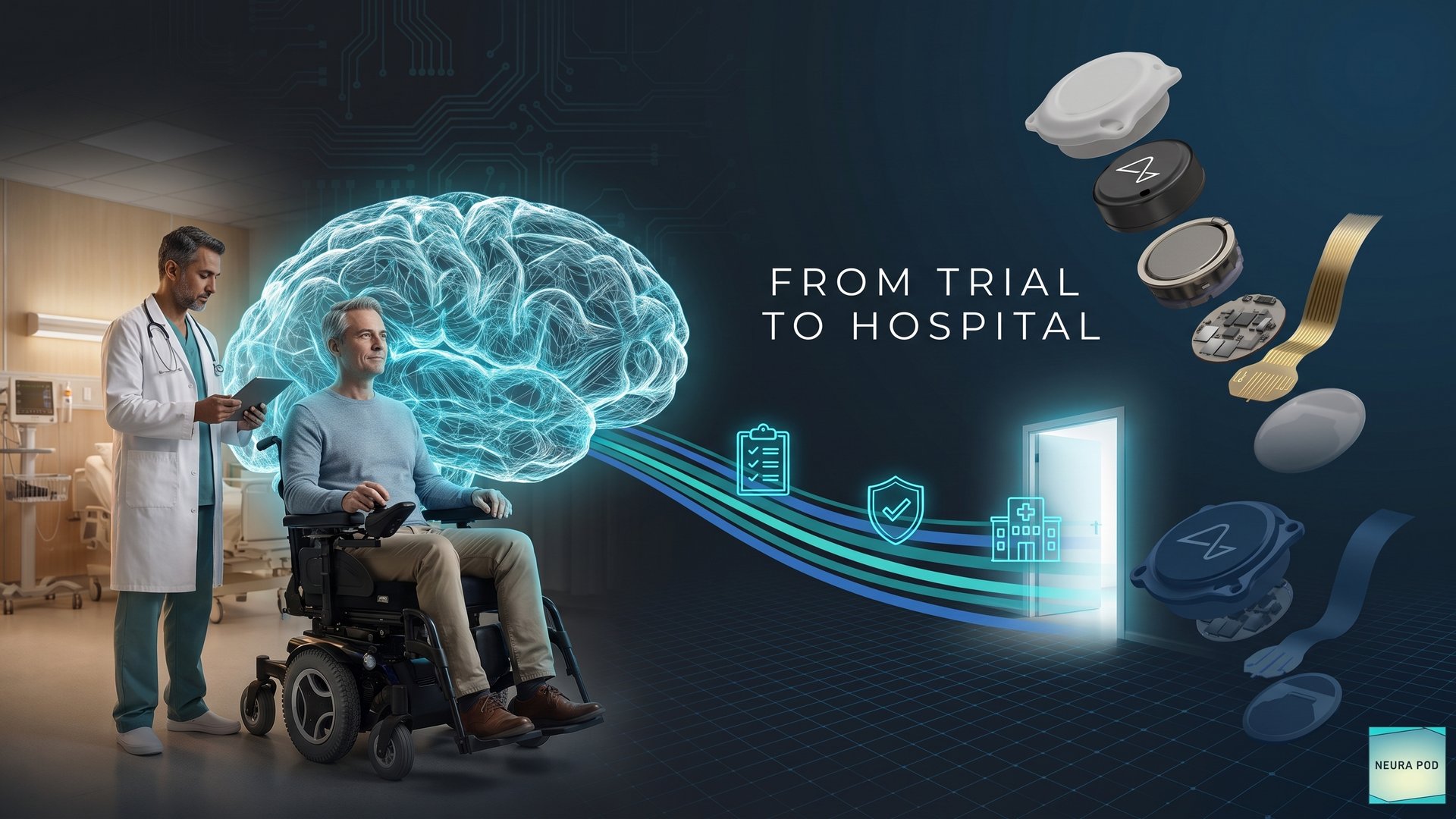
- Terry, the third VOICE trial participant, tells his wife "I love you" with a voice decoded from his brain
- Kenneth, Jon Noble, LeBrain James, and Elon on Neuralink to Chinese state TV
- Who runs the surgical robot, a busy month for competitors, China's brain-data rule, and Apple's Sonera deal
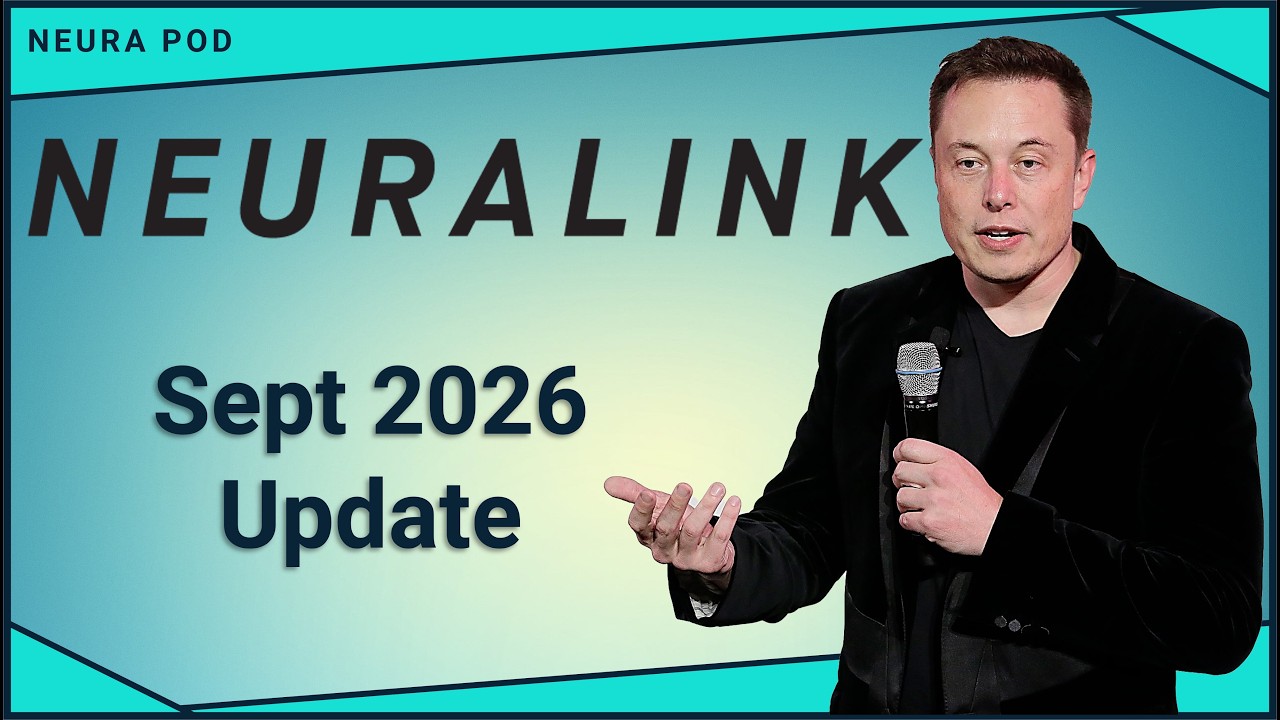
In this September 2026 Neuralink update I cover the video of a Neuralink patient who lost his voice to ALS saying 3 words to his wife, what patients Kenneth, Jon and LeBrain James are up to, and what Elon said about Neuralink on Chinese state television. I also look at what an engineer says the robot does during surgery and who Neuralink is hiring to run it, a busy month for the competition, a new brain-data rule out of China, 2 brain discoveries from Stanford and Google, Apple's acquisition of a brain and muscle sensing company, and the latest employee count and social metrics. For prior months, see the August 2026 Neuralink Update, the July 2026 Neuralink Update, and the Neuralink Update for 2026.
A Beautiful Surprise
On September 16, Neuralink posted a 22-second video with a 3-word caption: "A beautiful surprise."
A beautiful surprise.
— Neuralink (@neuralink) September 16, 2026
The man in the clip is Terry, the third participant in Neuralink's VOICE trial. He has bulbar-onset ALS, a form of the disease that starts in the muscles of the mouth and throat, so his speech went first while his arms and legs still work. His wife, Lori, describes him as a natural extrovert, and losing the ability to speak took a lot away from him.
Two days later, Neuralink posted the full story. The implant reads the speech signals in Terry's brain, AI turns them into words, and a voice rebuilt from recordings of Terry made before ALS says them out loud. Neuralink's VOICE clinical trial is investigating how a brain-computer interface (BCI) can restore the ability to communicate for people with severe speech impairment.
Video: Terry, VOICE trial participant, speaking with the mind.
— Neuralink (@neuralink) September 18, 2026
Partway through that video, Natalie, a member of the Neuralink team, mentions that Terry's implant has 3,000 channels. This is the first time the company has said an implant placed in a person has that many. Each channel is a stream of brain data, so more channels give the decoder a clearer picture of what the patient is trying to say. Earlier devices had about 1,000 channels, and Neuralink has said future devices for Blindsight and other applications will have more than 10,000 combined channels.
Neuralink's President, DJ Seo, added more context for how the system works:
The participant initiates this with a key press, thinks the words ‘loudly’, then commits with a second key press.
— DJ Seo (@djseo) September 17, 2026
What you hear is his own voice, trained and generated by Grok @SpaceXAI
Terry presses a key to start, thinks the sentence, and presses a second key to send it to the speaker. He can still use his hands, which is why this setup works for him. Terry then replied to Neuralink himself:
Thanks to you and the team at Neuralink for making this moment possible for my wife and I. Neuralink has been a tremendous gift for us during my battle with ALS!
— Terence Mandable (@BluetoothTerry) September 17, 2026
We have more to achieve, so let’s get back to work! Hopefully someday we’ll even get it integrated in my Tesla, although perhaps a new roadster would be a better test device than my 2018 Model3, just sayin’…
Terry Speaks With His Mind
On September 22, CBS Evening News covered Terry's story:
"We’re back with the good stuff. We’re all talking about the risks and the dangers of new technology, but our story tonight is about the opposite of all of that. Terry Mandable was at the peak of his life when ALS disease robbed him of his ability to speak. But now with an experimental brain chip that essentially reads the waves of his mind and an AI-backed program that translates those readings into speech, Mandable can once again say what he’s feeling."
Back in January, Elon said a next-generation implant with about 3 times the capability would arrive later this year, and in March, DJ posted that the team was working on a design with 10 times the capability that would scale to 100 times.
Neuralink's YouTube video, "Speaking With The Mind", shows Terry's first session after surgery. The implant went into the speech motor region, the part of the brain that plans how the mouth, tongue and larynx move, so the team asks Terry to attempt a phrase and watches the signals respond.
"One thing you can try to do, is we can try and get these to light up a little bit. Since we implanted this in the speech motor region, if you try and think or attempt speaking, we might be able to see some modulation. So now, do you want to try and give this a ‘hello world’?" "Hello world." "Okay, that’s pretty colorful."
From there, the team collects more brain data. Terry reads sentences off a screen, the implant records what his brain does while he attempts each one, and the decoding algorithm trains on the result. As Sammy from the Neuralink team explains, the engineers do not need to know every detail of what the brain signals mean, because the signals and Terry's intention carry the information. Tesla's self-driving team works the same way: when the fleet provides good data and the intentions are clear, the engineers can build a superhuman driver. Neuralink is applying that approach to the brain.
"You’ll start with this, it’ll turn blue, you’ll say what you want to say. Then you’ll press this button and that will say it out loud, through the computer speakers. Sound good?" "Hello, how are you doing today?" "You just got your voice back."
This setup differs from the one used by Brad, Neuralink's first patient with ALS. Brad moves a cursor with his implant, picks words on an on-screen keyboard, and AI speaks the sentence. Terry and Kenneth skip the keyboard, because their implants read the part of the brain that plans how the mouth, tongue and larynx want to move.
Neuralink Patients
Kenneth Shock, the 21st Neuralink patient and the second person in the VOICE trial, posted this:
ALS already takes enough of my time and energy. So I’m using Dictation mode along with Grok Bot @bot to help manage my X account — drafts, replies, scheduling — with me still approving what goes out. Working smarter so I can keep showing up.
— Kenneth Shock (@Cyborg21) September 13, 2026
Kenneth dictates with his implant to an AI agent that helps run his account, and he still approves everything that goes out. That connection between a human mind and AI is what Neuralink was created to build. Kenneth also launched a newsletter called I Am Cyborg 21, and its first piece is titled "Still Here. Still Trying." It opens like this:
"ALS sucks, but my life certainly doesn’t." I didn’t start writing online because I wanted a brand. I started because ALS is very good at shrinking a life down to appointments, fatigue, and the next thing you can no longer do. Writing — first in short posts, now here — is one of the ways I refuse that shrinkage.
A few days later, he posted:
I call myself a cyborg. The truth is simpler: I’m a husband, a patient, and someone who got another chance to be heard. Thanks @neuralink.
— Kenneth Shock (@Cyborg21) September 18, 2026
Next, Jon Noble, patient 18 and the fifth participant in the UK study, posted this at 261 days with his implant:
261 days as a @Neuralink pioneer.
— Jon L. Noble (@CheckCanopy) August 31, 2026
Every single day, calibration improved.
Every single day, Webgrid improved.
Not in giant leaps. In small, stubborn, measurable steps.
That is what I want others to hear.
The implant opens the door. Consistency walks through it.
261 days in, still getting better.
P.18/GB.5
Jon is a UK Army veteran with a C4 spinal cord injury from 2004, and on September 11 he had his 9-month post-op checkup. His note about the model getting better because you keep giving it cleaner intention matches what Kenneth described with the roughly 15,000 sentences he has read to train his decoder. The patient trains the model as much as the model serves the patient.
LeBrain James, patient 23, took his robotic arm to an Ohio State game:
Here is a robotic arm shot to THE Ohio State fighting spirit! The Buckeye Boys are back! Thanks to @neuralink for allowing me to push research forward and make it feel like I have purpose again and thanks to @OhioStateFB and @ryandaytime for the memories!
— LeBrain James (@LeBrainJames023) September 4, 2026
Purpose comes up in nearly every one of these posts. Kenneth wrote about it, Jon wrote about it, and LeBrain James wrote about it.
Elon on Neuralink to Chinese State TV
The day before Chinese President Xi Jinping's state visit to the White House, Elon gave an interview to China Media Group, the parent of CCTV. Most of the coverage focused on Tesla Shanghai and bullet trains, and DogeDesigner clipped the part about Neuralink:
Video: Elon Musk on Neuralink in an interview with China Media Group.
— DogeDesigner (@cb_doge) September 23, 2026
"Biological enhancement with Neuralink. We want to try to solve the bandwidth constraint that humans have. Even in the most benign scenario where the AI is super friendly and wants to do everything it wants to make you happy, our rate of communication is too slow. So, the peak human bandwidth is only about 100 bits per second, roughly. Our input bandwidth is much higher because of vision, you know, a megabit per second or a few megabits per second from our eyes. But our output bandwidth is really low. Computers are communicating at a trillion bits per second. Anything we can do to increase the communication speed of humans will improve, I think, the alignment of humans and machines, because otherwise to an AI that is communicating at a terabit a second, talking to a human will be like talking to a tree."
Anyone who uses AI models every day knows that typing or speaking is the bottleneck for getting ideas out. That puts the VOICE trial in a different light, because the technology that gives Terry back a sentence is the first step toward letting anyone get a thought out of their head faster than their mouth can move.
Elon also posted this:
The brain is a biological computer. Just like silicon computers, some brains have more processing power or specialist skills than others and this varies tremendously in humans.
— Elon Musk (@elonmusk) August 30, 2026
The probable capabilities of any given brain can be determined with high accuracy from an MRI. At Neuralink, we obviously have to understand brains extremely well to interface with them effectively, so there is no room for nonsense.
Who Runs the Robot
Danish Hussain, a Neuralink lead who used to be a firefighter, answered a question about whether engineers will end up doing the surgery. In the past, certified neurosurgeons performed every step of brain surgery. Danish expects autonomous robots to perform it in the future, and he describes Neuralink as being in the stage between the two, where a neurosurgeon does part of the procedure and a robot does part under the neurosurgeon's discretion. No engineer performs surgery at any point, but engineers can join to build the machine that does.
no. in the past, brain surgeries were fully conducted by certified neurosurgeons. in the future, they will be fully conducted by autonomous robots.
— Danish Hussain (@astrodanish) August 27, 2026
I broke down more of this in a short:
Video: how the Neuralink surgical robot and neurosurgeon share the procedure.
— Neura Pod (@NeuraPod) September 23, 2026
CJ, Neuralink's 24th patient, replied with this:
Pretty sure I learned more about my own surgery from @NeuraPod than from anywhere else
— CJ (@SCI_Borg24) September 23, 2026
Neuralink is also hiring people to run the robot. A Neurosurgical Robot Operator role at the ATX1 campus in Austin went up on the careers board on September 10.
Two people also posted about joining the team. Robert Dale Smith, a developer, wrote:
You hear about developers landing dream jobs from their open source work.
— Robert Dale Smith (@RobertDaleSmith) September 12, 2026
Turns out that can actually happen.
I’m joining Neuralink Monday.
Chris Keach quoted that post and added:
I wanted to work at Neuralink for over 6 years. Yet I never applied because I always told myself I wasn’t good enough. ‘dream job’ was always just that: a dream. One day I decided not to overthink and apply. Don’t be like me, don’t wait 6 years!
— Chris Keach (@cchriskeach) September 12, 2026
A former employee, Jeff, wrote that the 2021 video of the monkey Pager playing Pong is what got him to apply. He got the job, and he has never been on a team like it before or since. If you have been doubting whether you would fit the team, apply anyway at neuralink.com/careers.
The Competition Had a Big Month
First, Paradromics, the other brain-computer interface company in Austin, announced real-time speech with its Connexus BCI. Their first patient is a 68-year-old woman in Michigan with a motor neuron disease that took her speech. She was implanted in June at University of Michigan Health with the Connexus device, which has 421 electrodes. In September she generated her own sentences in real time, answered open-ended questions, and spoke with her grandchildren on a live phone call. The first sentence she chose to say on her own was:
"Okay, I have a lot to say."
When her neurosurgeon asked what she would tell someone considering the study, she said:
"Don’t be afraid. It’s a wonderful experience to help others by participation in research."
Paradromics CEO Matt Angle said she determines what she wants to say, and the system enables her to say it.
Second, Science Corporation, the company founded by Neuralink's former President Max Hodak, posted this:
Blind Stargardt patient reads letter again in PRIMA by Science clinical trial.
— Science Corporation (@ScienceCorp_) September 24, 2026
Stargardt disease destroys central vision, and no existing treatment brings it back. This patient became legally blind and could no longer read or recognize faces. He joined the trial of Science's PRIMA implant, which is approved in Europe for geographic atrophy and is now being tested in patients with Stargardt disease and retinitis pigmentosa. During his first rehabilitation session after surgery, he saw a letter again. Max added that every PRIMA patient until now had age-related macular degeneration, that this is their first Stargardt patient, and that the study, called PRIMalia, is enrolling in Sydney.
PRIMA differs from Neuralink's upcoming Blindsight product. Blindsight places an implant in the visual cortex that connects wirelessly to a pair of cameras, while PRIMA goes under the retina. A person who was legally blind saw a letter in his first rehab session, and I am rooting for every one of these efforts.
Third, Merge Labs, the Sam Altman company that is trying to read the brain with ultrasound instead of electrodes, signed a multiyear deal that makes Butterfly Network its exclusive supplier of ultrasound-on-a-chip. Merge co-founder Sumner Norman posted his congratulations to both teams.
Fourth, Subsense, a Palo Alto startup that wants to get nanoparticles into the brain through the nose and read them with a headset, added Ray Kurzweil as a product and vision advisor. The company has raised $27 million and is aiming for a first human pilot in 2027.
Fifth, a paper in Nature Neuroscience showed one implant on the surface of the cortex, with 253 electrodes, decoding speech and upper-body gestures at the same time in 3 paralyzed participants, so an on-screen avatar can wave while it says hello.
The competition keeps heating up, which is also why a regulator on the other side of the world decided this month that the data coming off these devices needs to follow stricter rules.
China’s Brain-Data Rule
According to Tech Times, on September 15 China's National Medical Products Administration, the country's equivalent of the FDA, issued the world's first binding technical standard for how AI in a medical brain-computer interface handles brainwave data. It covers 5 stages: collection, processing, labeling, storage, and access. It takes effect September 1, 2027. The article also reports that BCI investment in China in the first 4 months of this year passed the total for all of 2025.
The standard is one piece of a bigger plan. The South China Morning Post reported in August that China's Ministry of Industry and Information Technology wants more than 40 brain-interface standards written by 2028 and more than 80 by 2030, with at least 100 companies adopting them. The article names Neuralink as the company those firms are competing with.
This matters for Neuralink because of its data. Neuralink's machine learning team describes its work as building foundation models that decode neural signals directly, and that neural data may be the most valuable asset the business has. DJ has said counterintuitive patterns are already showing up with only a couple dozen patients. China's rule does not tell us which regulations will apply in the US, but I expect ongoing debate about the right way to handle this data. I believe Neuralink will set stricter standards for this data than any regulator requires.
Two Brains and a Fruit Fly
A Stanford Medicine team led by Kyle Loh published research in Nature Neuroscience finding that what we call the brain is two distinct organs that evolved separately over more than 550 million years. The forebrain and midbrain, which handle language, reasoning, and consciousness, come from one progenitor cell in the embryo. The hindbrain, which runs breathing and heartbeat, comes from a different one. For decades, the accepted model had one cell giving rise to the whole brain.
I want to be careful not to overpromise here. The one safe prediction is that AI will make scientific discoveries and engineering breakthroughs arrive faster than they have in the past.
Finding the hindbrain's origin let the team grow human hindbrain motor neurons in a dish for the first time. ALS destroys those neurons, spinal muscular atrophy destroys them in infants, and until now researchers could not make them to study. Loh said the discovery means they can now grow neurons from the back of the brain in a petri dish.
Google Research, working with the Janelia Research Campus, the MRC Laboratory of Molecular Biology, and the University of Cambridge, released the complete wiring diagram of a male fruit fly brain: 166,000 neurons and 125 million connections, the largest brain map by neuron count so far. Anyone can explore it in the open-source tool Neuroglancer. The female fly was mapped earlier, so researchers can now compare the two cell by cell.
A human brain has around 86 billion neurons, so the fly map covers a fraction of a percent of that. It took some of the best labs on Earth years to get here, and mapping a human brain in the same detail will move much faster.
This is one reason the data coming off a fleet of Neuralink implants will matter so much. Nobody is going to map a human brain from the outside, but Neuralink could do it from the inside. And if they can map it, they can recreate it.
Apple’s Sonera Acquisition
An article from Benzinga, titled "Apple Is Chasing Elon Musk's Neuralink Vision, Differently," reports:
"Apple acquired California-based startup Sonera in May, according to newly disclosed European Union filings. The startup developed compact magnetic sensors capable of detecting tiny magnetic fields generated by the brain and muscles without requiring skin contact or implanted devices."
Sonera was founded by UC Berkeley researchers Nishita Deka and Dominic Labanowski. It started with muscle monitoring before expanding into technology that could eventually enable everyday brain sensing, and its website went offline after the acquisition. Apple has not said how it plans to use the technology.
Sensing from outside the body is a different path from building an implant. But Apple and every other major tech company are investing heavily in wearables, so it would not be crazy to assume they are working on BCI technology. The Apple Vision Pro, Meta's headsets, and other wearables are Neuralink-lite. I expect all of them to come around to building something like Neuralink that goes under the skull, and the ones that don't will be left behind.
Employee Count and Social Metrics
Here are the approximate employee count and follower numbers as of September 27, 2026:
Estimated employees: 365 (LinkedIn associated members divided by 1.90). LinkedIn followers: 427K. Instagram followers: 161K, up from 147,367 in late August.
Please share the link to apply for Neuralink's human trials, neuralink.com/patient-registry, with anyone who could benefit from it. If you know someone who would be a good fit as an engineer or to run the robot, send them to neuralink.com/careers.
Next week I'm releasing a conversation with Neuralink patient CJ and his wife, Bynthia, so subscribe on YouTube to catch it. I'm also speaking at the X Takeover event at Tesla's Austin Gigafactory on October 10, hosting a panel with Ellie in Space and Jake Schneider, the 7th Neuralink patient. If you will be there and want to meet up, message me on X at @NeuraPod.
Summary
September 2026 on Neuralink: Terry, the third VOICE trial participant, spoke to his wife with a voice decoded from his brain on an implant with 3,000 channels, and CBS Evening News covered his story. Kenneth, Jon Noble and LeBrain James shared their progress, Elon explained the bandwidth mission on Chinese state TV, and Neuralink is hiring operators for its surgical robot. Paradromics, Science Corporation, Merge Labs and Subsense all made news, China issued a brain-data standard, Stanford and Google published 2 brain discoveries, and Apple acquired Sonera. Neuralink now has an estimated 365 employees.