Neuralink Update — May 2026
In this article:
- Patient updates
- VOICE trial
- Elon's posts about Neuralink
- Neuralink's robot
- Patent for safer surgeries
- Elon makes a bet
Patient updates
The patient updates this month continue to show meaningful progress for people living with paralysis and ALS. The 23rd patient, who goes by the humorous handle @LeBrainJames023 on X, shared this:
@NeuraPod https://t.co/PkaXramysn Just so you have an idea of what I'm doing with my BCI in my free time. I should have documented more of me building it, but I didn't. That's my mistake.
— LeBrain James (@LeBrainJames023) May 8, 2026
And here's a link to his BCI Arcade game: https://bciarcade.com/.
As you can see, he's created several different games in what he calls his BCI Arcade. I chose to play Putt-Putt, which as a physically healthy man, I currently have an advantage in using my computer mouse; however, my prediction is that this year is the year when Neuralink patients will consistently achieve higher bit rates than able-bodied individuals. Think about how important this is. This is the whole point of Neuralink. Having a brain-computer interface means you can interface with your computers more effectively than you could right now. And right now, the main way we interface with our computers is our mouse and keyboard.
So this bits per second number is an easy way to quantify in a single number how "effective" a brain-computer interface is. And just a side note, bit rate is very similar to bandwidth, so whenever I or others say Neuralink is creating a "high-bandwidth brain computer interface," we're referring to the ceiling on what the bit rate could be for that device.
Here's a link to the WebGrid game: https://neuralink.com/webgrid/
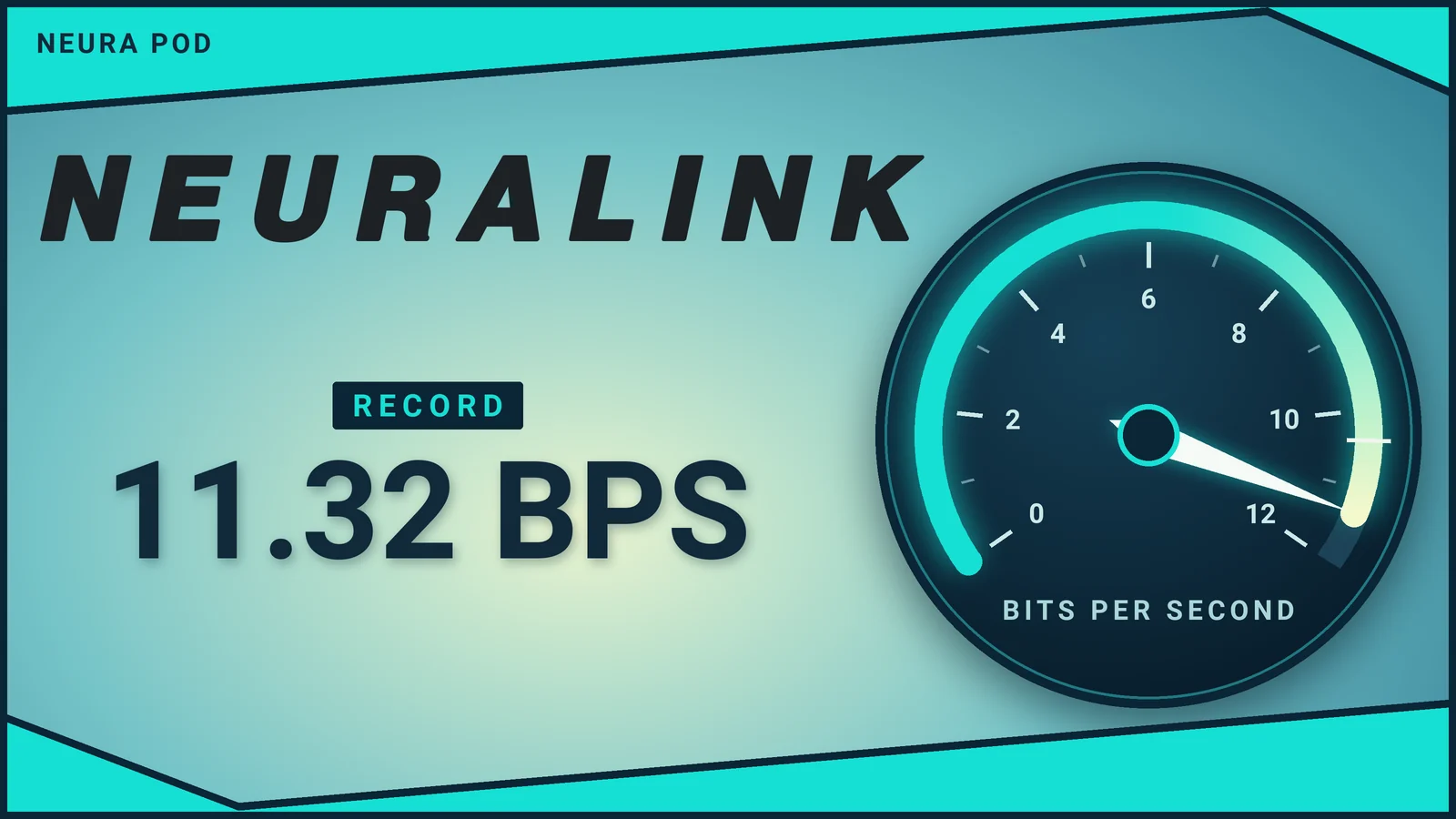
Now the reason I say I believe this is the year Neuralink patients will consistently achieve higher bit rates than me, for example is because on this page on the Neuralink website, you can test what bit rate score you can achieve in an apples to apples comparison, and some of the patients have already achieved rates beyond 10 bits per second of information sent from the brain to the computer.
I can regularly get scores in the 8 to 9 bits per second range, sometimes a little more. Go ahead and try it out yourself if you so fancy.
For context, here is a video from Google DeepMind, which is probably tied for the best AI lab in the world:
We’re reimagining a 50-year-old interface - the mouse pointer - with AI. 🖱️
— Google DeepMind (@GoogleDeepMind) May 12, 2026
These experimental demos show how people can intuitively direct Gemini on their screens using motion, speech, and natural shorthand to get things done 🧵 pic.twitter.com/p6fhgNcopz
The main reason I wanted to share this context is that this is a leading AI lab that is doing this work. If any group is going to build this well, they are. And while sure, I myself would find this useful right now if I used voice commands more frequently, it will still be nothing compared to having a Neuralink. That is to say, any of these incremental improvements, no matter how amazing they actually are, will be small when Neuralink is able to do all they want. So for the next few years, we can continue to appreciate all these amazing, useful tools, while also looking forward to a crazy future that only Neuralink can enable.
And then back to the 24th Neuralink patient, CJ, who got his surgery in Miami. He's quite active on X @SCI_Borg24. This is part of a message from CJ's wife:
CJ's Air transportation goal has been met: https://www.givesendgo.com/air-ambulance-for-neuralink
"In 2020, CJ finally realized his dream of starting his own CAD business. After he was furloughed, he decided he would rather be self-sufficient than take Unemployment. He worked for months to establish this business, and he successfully earned his first job on June 19. Later that day, while trimming a tree in the front yard, a 300-lb branch broke overhead, knocked him to the ground, and fell on him. Before EMS arrived, he coded, [or, went into cardiac arrest] but they were miraculously able to resuscitate him.
He underwent a botched emergency spinal fusion, coded again, and was brought back to life, but now quadriplegic and dependent on a ventilator to breathe. His dream of running his own business launched and crashed on the same day. He endured a nightmarish stay in the ICU, with staff repeatedly telling him to turn off his ventilator and pass away, because his life would not be worth living."
This is the power of Neuralink: it gives hope to so many people. Just having even a chance of a better life in the future gives a reason to keep fighting. I will be interviewing CJ and will post it here and on X.
And then this was some cool insight into a historic meeting of the minds:
Last week, for the first time ever, Neuralink Cyborgs met each other as a group. It was meaningful in many ways. Since my accident, I have been a bit of a hermit due to self-imposed isolation. I lost my old life so quickly, and all of the travel, activity, and independence that… pic.twitter.com/0lVyYYijYE
— CJ (Neuralink P24) (@SCI_Borg24) May 15, 2026
By the way, there are now at least 26 patients, which I will continue updating at https://www.neurapod.com. We are also seeing early encouraging signs from patients participating in the new VOICE, speech restoration trial.
VOICE trial
Neuralink's VOICE trial is already producing strong results for people with ALS who have lost the ability to speak. The study focuses on restoring natural-sounding speech directly from thought, and the early patient stories are moving.
Now I recently came across this article that seems like it could be referring to Neuralink. It is not, but it is nice that others in the field are working on these devices: https://www.science.org/content/article/brain-implant-lets-man-who-lost-his-speech-als-produce-natural-sounding-sentences
You can compare to Neuralink by watching this detailed video I made about the VOICE study. You can watch the video version, or read the blog post version.
This technology transforms daily life for these patients; just being able to participate in conversation gives them a sense of belonging. Being able to say simple things like: "Good morning" or "How are you?" are part of what fulfill our social needs.
These early VOICE trial results build beautifully on everything we have seen in the PRIME study and show how Neuralink is expanding its impact beyond cursor control to full communication.
Elon's posts about Neuralink
Elon and Beff Jezos recently discussed brain-interfaces on X:
True. Only way that we can even try to keep up with AI.
— Elon Musk (@elonmusk) May 18, 2026
Then he posted this a couple days later:
Our brains lack a math co-processor, but Neuralink can probably provide that one day
— Elon Musk (@elonmusk) May 21, 2026
I like that he shared this because it gives us a useful way to think about what Neuralink is. AI, or digital intelligence is improving at a very fast rate, but we remain bandwidth constrained. The connection from our brains to those devices is sloth-like. Maybe in the future, we'll be able to have many different types of "plug-ins" if you will.
Then wanted to share this video from Senator Ted Cruz:
Great to tour and visit with the minds and leaders behind @neuralink in Austin.
— Senator Ted Cruz (@SenTedCruz) May 7, 2026
Neuralink’s next generation technology is transforming lives, and we’re proud to have them in Texas. pic.twitter.com/XI945osxSd
Neuralink's robot
Neuralink recently published a video called "Automating Neurosurgery with Robotics" that gives us a great look behind the scenes at how they are making the implant procedure even more advanced and safe. (watch 00:13 to 00:45 and 03:38 to 04:02).
The more precise and less traumatic the surgery becomes, the more scalable this is, and humanity won't have to worry about training a bunch of neurosurgeons. More patients will be able to benefit from this life-changing technology. This showcases the team's deep commitment to safety and scalability.
I also wanted to share this post from Elon:
Medical care of all kinds will be done by robots
— Elon Musk (@elonmusk) March 21, 2026
He is probably referring to Optimus and the Neuralink surgical robot. I first raised this in a 2020 video: Neuralink will eventually have the most advanced medical robot on the planet and I don't expect them to get in the business of selling these medical robots, but they could if they wanted. Potentially Tesla could do the manufacturing.
Patent for safer surgeries
Neuralink published a patent that focuses on making their brain surgeries even safer: https://patentimages.storage.googleapis.com/c3/c5/29/25db64872efb6d/US20240386571A1.pdf
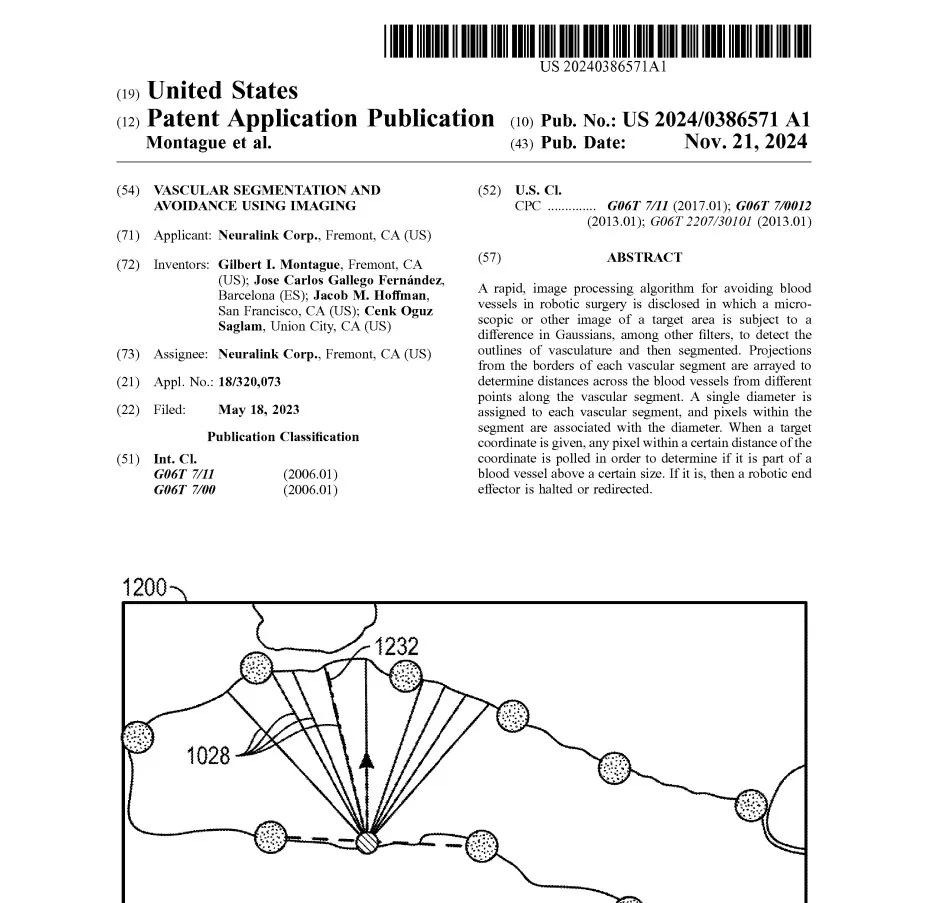
This patent describes a tool that helps the surgical robot better identify and avoid blood vessels in the brain before inserting the extremely thin threads. The goal is to reduce any risk of puncturing vessels and minimize damage to brain tissue as much as possible.
You can see how the robot carefully inserts these super fine metal probes, each thinner than a human hair and carrying 8 tiny electrode sensors. Avoiding blood vessels is critical so the sensors stay clear and the brain tissue remains as healthy as possible.
Our surgeons use the lasso tool to highlight relevant brain regions based on fMRI. The robot leverages high resolution cameras to automatically place targets in the region of interests while avoiding the tiniest vessels that are not easily visible to the naked eye 🤠 #techtuesday pic.twitter.com/efFmuB16sa
— Neuralink (@neuralink) June 28, 2023
To understand why this matters, it helps to compare it to older technology like the Utah Array.
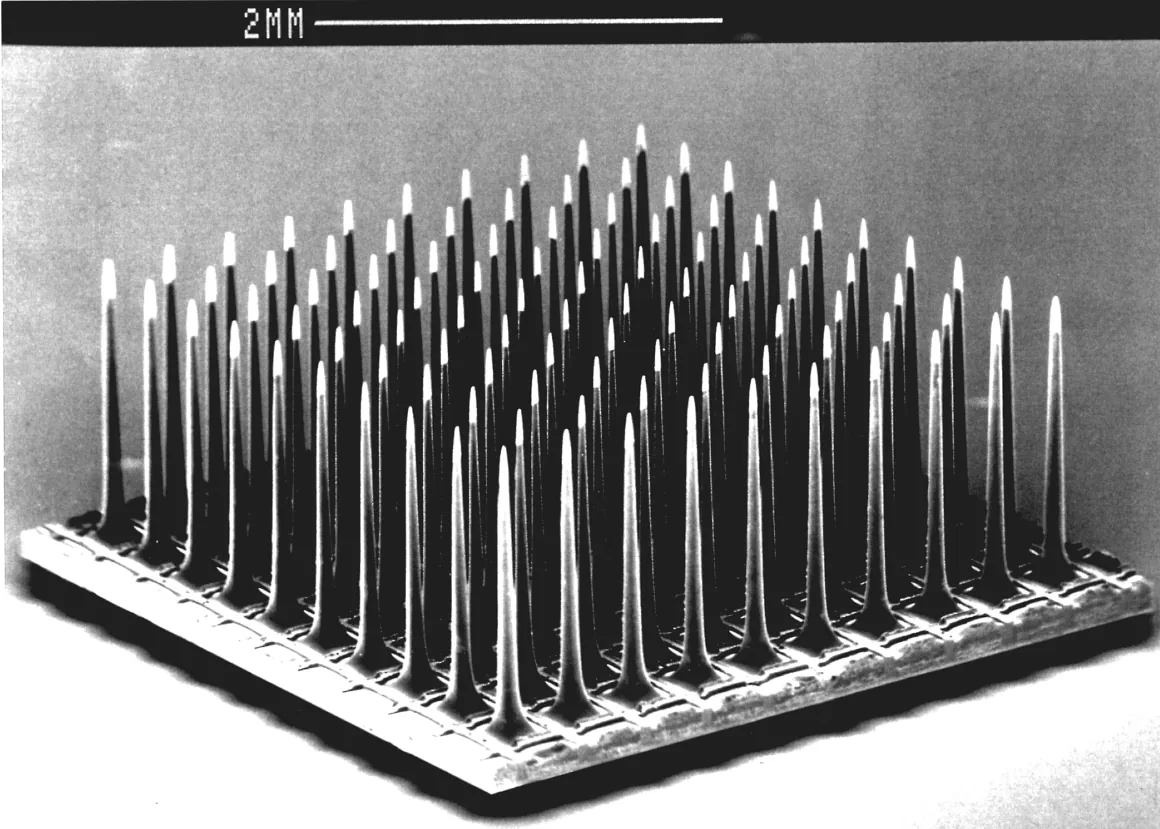
The older approach was basically like hammering a grid of needles into the brain. It worked, but it was far from ideal.
Neuralink's Head Neurosurgeon, Dr. Matthew MacDougall and Elon Musk had this to say at a live update in July 2024:
"The historical approach is to actually pound in a sort of bed of nails with an air hammer into the brain. It looks crazy! …literally just hammering in what looks like a bed of nails into the brain. It actually works! It's astonishing that it actually works at all... Those are several orders of magnitude more volume of brain tissue that you're destroying compared to what we're doing."
Neuralink's approach is completely different. They have built a custom robot with high resolution imaging and now this new tool using fMRI to map out safe paths. Elon later followed up saying this:
"The Neuralink device is something that really absolutely minimizes damage to the brain. Absolutely minimizes the load on the patient. And the goal is to allow someone to live a completely normal life. You won’t even notice that someone has the device."
If you ask me, this focus on safety and precision is one of the things that sets Neuralink apart. It shows how seriously the team takes their responsibility to the patients.
Elon makes a bet
Here's what Elon said on the "Moonshots" podcast by Peter Diamandis:
"I think they're getting clean rooms wrong by the way in these modern fabs. I'm gonna make a bet here. [Okay.] [Okay.]… that Tesla will have a 2 nm fab and I can eat a cheeseburger and smoke a cigar in the fab. [Oh, okay] [Oh come on.] [The air handling will be that good?] [Okay, you have this sketched out in your mind? Like how are the atoms being placed if they're being immune to cheeseburger grease?]"
For some context, let's throwback to 2023, to this video of Neuralink's cleanroom:
A quick tour of our cleanroom, where our microfab team makes tiny electrodes to implant in the brain so that neurons experience minimal disturbance. It's our labor of love ❤️ pic.twitter.com/LtGTFYYLYs
— Neuralink (@neuralink) September 6, 2023
Since this video is from a few years ago, the team has made improvements to the electrode threads design, but my bet is they still have some fun animals on the wafers. I see a rabbit, a no-freestyling sign, an octopus, and is that last one a goofy pig, or something else?
Also, Brad (P3) shared this when he went to visit Neuralink in Fremont:
When I visited @Neuralink, they gave us a tour of the micro fabrication department where they make the tiny threads that go in my brain!
— Bradford G Smith (Brad) (@ALScyborg) July 17, 2025
It was AMAZING!
They are basically taking silicon wafers, in Silicon Valley, and turning them into threads. They have crazy small hooks for… pic.twitter.com/aiBMgHKgz8
Elon went on to add this is how they'd win the bet:
"You just maintain wafer isolation the entire time- which is actually the default for fabs. The wafers are transported in boxes of pure nitrogen gas, under a slight positive pressure. [You know, so are the bananas at WalMart? Just so you know.] Yeah, well that's insecticide essentially- like it's pretty hard for anything that's combusting to live without oxygen. So like you can kill the bugs just by putting a nitrogen blanket on plants. [Oh, interesting]."
So whether it's Tesla with the Terafab or Neuralink's microfab, we'll have something to look forward to seeing as Elon eats his favorite food: a cheeseburger.
I very much appreciate all of you who have joined as channel members, all of you who comment your thoughts and support on the videos, and you just watching here to the end. Because I've come to realize this really is my life's work. At least for now, this is my life, and so you caring at all, even if it's only due to an interest in Neuralink, is great.
And if you've made it this far in the article, I predict you're a real supporter. So I would like to ask you to check this out as well. This past week, I worked on writing an article discussing all the key information to prepare for the SpaceX IPO. It's on my new website called: "elonexplained.com", which I'm sure you can imagine I was happy to get the domain for after a couple years of it not being available:
https://elonexplained.com/spacex/ipo

Let me know what you think of the graphics and data visualizations. Thanks again, and see you in the next update.