- FDA human trials let Neuralink study its implant in people under an approved research plan, and that approval covers the study only.
- Before a hospital can offer a brain implant to regular patients, the FDA usually has to approve a Premarket Approval application for one specific medical use.
- Breakthrough Device designation gets a company more FDA feedback and a faster review, and the device still has to meet the same safety and effectiveness standard.
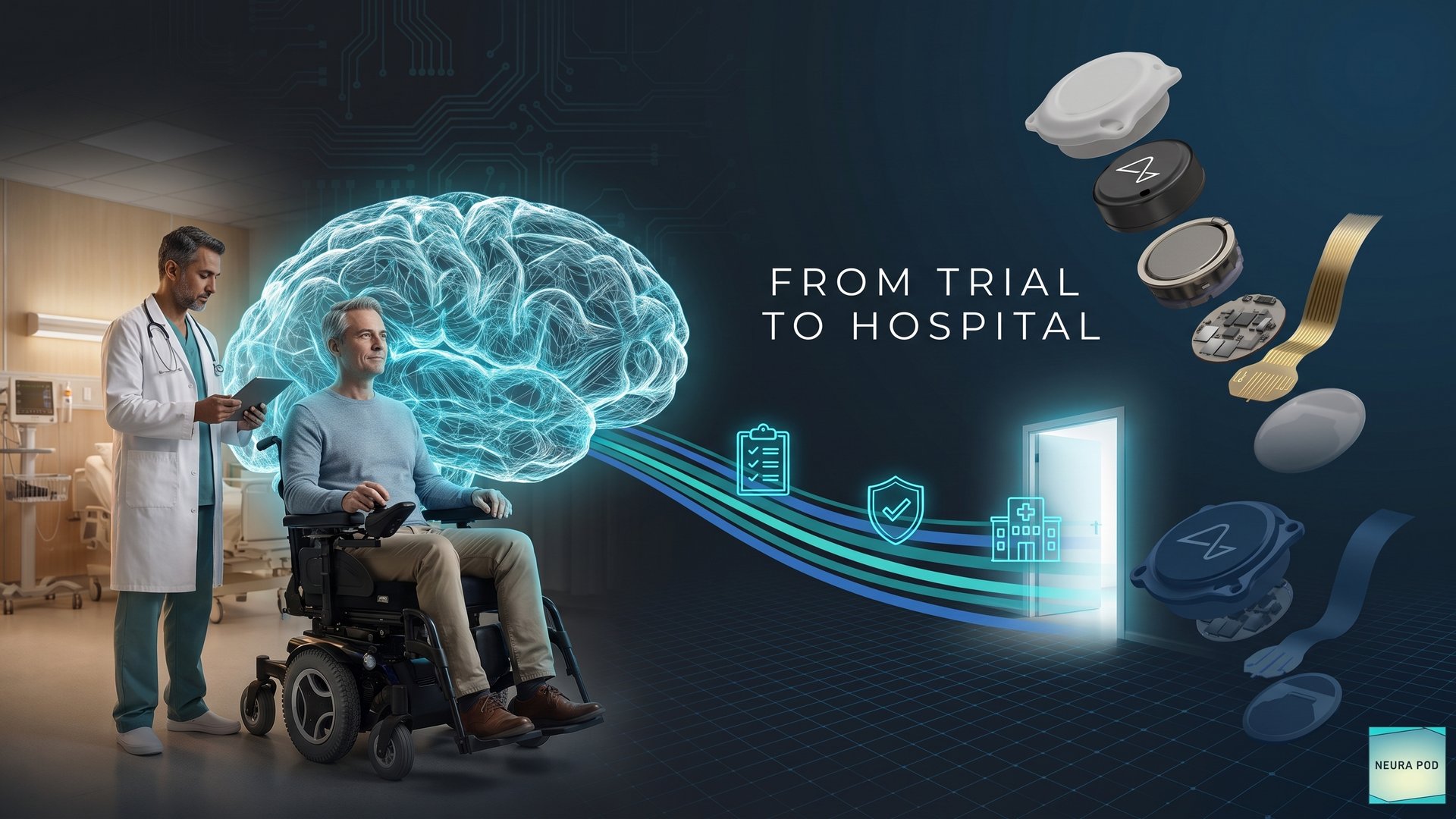
A daughter whose father has ALS watches a Neuralink patient move a cursor with their thoughts, and the first thing she wants to know is how her dad can get one. For almost everyone in her position, the real answer right now is a clinical trial, because the device is still investigational. Getting from those trials to a device regular people can get takes several more steps, and most of them happen after the part that makes the news.
When I say a device regular people can get, I mean a prescription implant that a hospital can offer outside a trial. The FDA, the U.S. agency that decides which medical devices can be tested and sold, has to authorize it for a labeled use. Insurance usually helps pay, the same way it works today for a pacemaker or a cochlear implant.
Why a brain-computer interface is a Class III medical device
The FDA sorts devices into three risk classes. Class I is the lowest risk, and the agency's own examples include elastic bandages. Class II is moderate risk and needs special controls on top of the general rules every device follows, with examples like powered wheelchairs and some pregnancy tests. Class III covers devices that, in the FDA's words, "support or sustain human life, are of substantial importance in preventing impairment of human health, or which present a potential, unreasonable risk of illness or injury."
A brand-new implant that puts electrodes into brain tissue lands in Class III by default. The law treats a new kind of device that wasn't commercially distributed before May 28, 1976, and isn't substantially equivalent to a device already classified, as Class III until the FDA decides otherwise. Because of that default, a brain-computer interface is expected to go through the FDA's toughest marketing review.
FDA human trials start with an Investigational Device Exemption
Before an experimental high-risk device goes into a person, the company needs an Investigational Device Exemption, or IDE, which is the FDA's approval to test the device in people under a written study plan. A significant-risk study also needs approval from an IRB, the ethics board at each hospital that protects the volunteers. Both approvals cover the study, so a company with an IDE can ship devices to its trial sites but can't sell or advertise them.
Neuralink got there on May 25, 2023, when the company posted on X that it had received "the FDA's approval to launch our first-in-human clinical study." That study became PRIME, and Neuralink opened recruitment in September 2023. It was a huge day for a team that had spent years on bench and animal testing before one person could volunteer.
The U.S. PRIME study enrolls adults with severe quadriplegia from a spinal cord injury or ALS, the disease that gradually shuts down the nerves controlling the muscles. According to the trial record, that means very limited or no movement in the hands, wrists and arms and everything below them, lasting at least a year without improvement. I walked through the implant, the robot, and what participants use the device for in my breakdown of the PRIME Study.
From early feasibility to a pivotal study
Device trials use their own labels instead of the Phase 1, 2 and 3 names people know from drug trials. A new implant usually starts with an early feasibility study, where a small group of volunteers shows whether the basic idea works and whether the risks look manageable. If the data holds up, the company moves on to a pivotal study, a larger trial designed to prove safety and effectiveness for one intended use.
In fact, the FDA approves a device only for that labeled use in a described group of patients. So the first approved brain-computer interface would most likely cover one condition, and that's why trial rules are so specific. Neuralink's VOICE speech trial takes people with severe speech impairment and impaired use of their arms and hands from ALS, spinal cord injury, stroke, or PLS (primary lateral sclerosis, a rarer relative of ALS). I covered how eligibility changes from study to study in this guide to Neuralink clinical trial eligibility.
Premarket Approval for a high-risk implant
When the pivotal data is strong enough, the company files a marketing application. For a new high-risk implant that's usually a Premarket Approval application, or PMA, filed under 21 CFR 814, the part of federal rules written for it. The FDA calls PMA "the most stringent type of device marketing application," and a company can't market the device until the agency approves it. Reviewers weigh the scientific evidence and decide whether the device is safe and effective for the use printed on its label.
Two lighter routes exist for lower-risk devices. A 510(k) is a clearance for a device that shows it's substantially equivalent to one already sold legally. The De Novo pathway is for a new low-to-moderate-risk device with no legally marketed predicate, meaning no earlier device to compare it to. Neuralink's threads go into the motor cortex, the part of the brain's outer layer that plans movement, and an implant like that fits neither description, so PMA is the expected route.
What the Breakthrough Devices Program adds
The Breakthrough Devices Program is a voluntary FDA program for devices that could treat or diagnose life-threatening or irreversibly debilitating conditions more effectively. A designated company gets more back-and-forth with FDA reviewers and prioritized review of both its IDE and its marketing application. In other words, a designated device has to meet the same evidence standard as any other device, and it gets its answers from the FDA sooner.
Neuralink announced designations for Blindsight on September 17, 2024, aimed at people with vision loss, and for speech restoration on May 1, 2025. As of June 30, 2026, the FDA had granted 1,320 designations across its device and biologics centers, and 210 of the 1,320 had a marketing authorization.
What happens after FDA approval
An approved PMA starts a new list of work for the company. Every device has to be built under the FDA's Quality Management System Regulation, the manufacturing rulebook in 21 CFR Part 820 that replaced the older Quality System Regulation on February 2, 2026. Its label has to match what the FDA approved, and the company files the post-approval reports the FDA requires. On top of that, the agency can order postmarket surveillance, a formal study of how the device holds up once it's in wider use.
Then come the decisions the FDA doesn't make. CMS, the federal agency that runs Medicare, decides separately whether Medicare will pay, and private insurers write their own policies. A hospital has to choose to start a program too, which means training neurosurgeons, buying the equipment and setting up follow-up care. I personally think this stretch gets the least coverage, even though it decides whether a family can find the device at a hospital they can reach.
Where Neuralink is on the FDA path today
Neuralink is running human trials under an FDA-approved IDE. On September 18, 2026 the company said again that its devices "are investigational and have not been approved by the FDA or other regulatory authorities." There isn't a PMA approval, so anyone who gets a Neuralink today gets it by joining a trial. Those trials carry real risks for the volunteers, and I went through them in my look at Neuralink's safety and risks.
Neuralink's last published count was 21 participants enrolled worldwide as of January 28, 2026. My own Neura Pod tally of publicly identified patients reached at least 27 by June 2026.
Elon said on X on the last day of 2025 where the manufacturing and surgery side was headed:
Neuralink will start high-volume production of brain-computer interface devices and move to a streamlined, almost entirely automated surgical procedure in 2026.
— Elon Musk (@elonmusk) December 31, 2025
Device threads will go through the dura, without the need to remove it. This is a big deal.
The dura is the tough membrane between the skull and the brain, so inserting the threads through it means the surgical team skips the step of removing it. Faster surgery and high-volume manufacturing are exactly what an approved implant would need before hospitals across the country could offer it. Every surgery done safely in the trials also adds to the evidence a future PMA would rely on. I'm extremely excited to watch the Neuralink team build the robot and the production line while the studies run.
Summary
For a family hoping to get a Neuralink today, a trial is the route, and the trial eligibility rules are the best place to start. From here, the next public signs of progress would be a pivotal study posted on ClinicalTrials.gov, the federal registry of clinical trials, and later a PMA filing. When either one shows up, I'll cover what it means for who can get the device.