Neuralink's 11.32 BPS Record: How 50,000 Hours of Data Did It
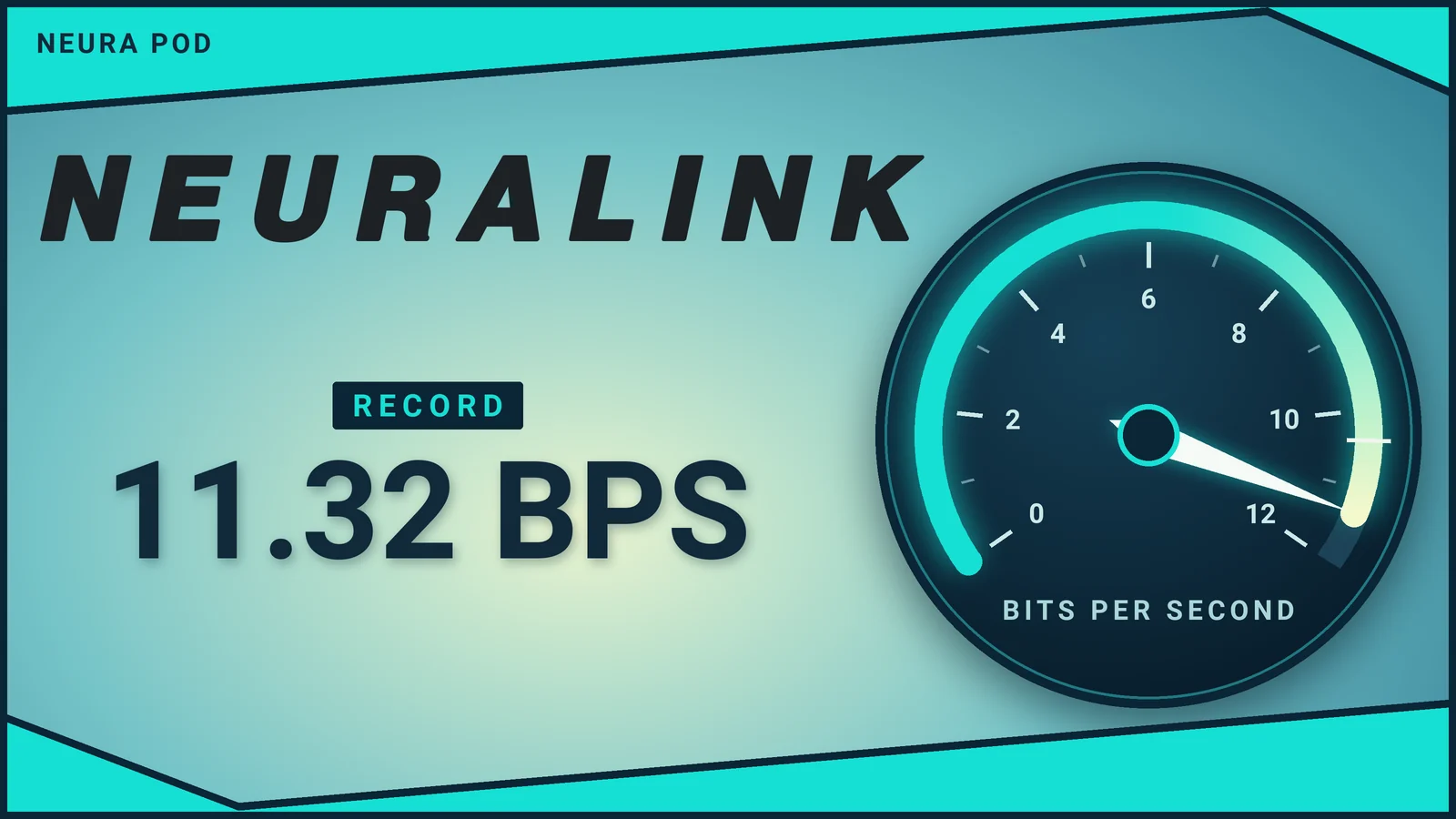
Neuralink says one of its clinical trial participants, known publicly only as P15, set a brain-computer interface record of 11.32 bits per second (BPS) after the company rebuilt its decoders on more than 50,000 hours of unlabeled brain recordings. The same change kept some decoders working for weeks without recalibration and cut some users' calibration time from 10 minutes a day to 10 minutes a week. The results come from a Neuralink engineering post published October 1, 2026, and have not appeared in a peer-reviewed journal.
What Neuralink announced
The post, titled Pretraining on 50,000 Hours of Unlabeled Brain Data, describes a change to the software that turns brain signals into cursor movement. That software is the decoder, a machine learning model trained to convert neural activity into an intended action such as moving a pointer or clicking.
Until now, each participant's decoder was built from short sessions of labeled data, meaning recordings where the system knew what the person was trying to do at every moment. Neuralink says its participants have streamed over 50,000 hours of freeform recordings in the two years since the trial began, and nearly all of it went unused. Its first participant, Noland Arbaugh, accounts for more than 9,000 of those hours, or about 22.4 billion spikes (the brief electrical pulses neurons fire).
BPS measures how much information a user transmits per second while selecting targets on a grid, so it rewards speed and accuracy together. Anyone can try the same test with a mouse on Neuralink's Webgrid page. The median Neuralink participant scores roughly 10 BPS. With the new decoders, six participants set personal records, three beat the previous record of 10.39 BPS, and P15 reached 11.32.
Why calibration took up users' mornings
Every Neuralink user calibrates before using the implant. During calibration, the user follows a set of structured on-screen tasks, and those tasks produce the training data for that person's decoder. The trouble is drift: the signals the implant picks up shift from day to day, so a decoder that worked well on Monday loses accuracy by midweek and the user has to calibrate again to win back control.
Neuralink puts the cost at an average of 55 minutes a week per user. Most users spent about 10 minutes calibrating at the start of each day, and some skipped days and accepted worse control to save the time. Each feature, such as typing or gaming, could also need its own decoder, so a more capable implant meant more setup. The company compared the routine to Sisyphus, the figure from Greek myth condemned to push the same boulder up a hill forever, since the data from each session was eventually thrown away.
How 50,000 hours of data became a better decoder
Neuralink's answer was pretraining. Engineers built an encoder for each participant, a model trained on that person's thousands of hours of raw recordings with no labels attached. This is self-supervised learning, where the model creates its own practice questions from the data. The encoder turns noisy, drifting spike data into embeddings, compact numerical summaries of brain activity that stay steadier from one day to the next. A small decoder trained on those embeddings then drives the cursor.
The company laid out five design bets behind the encoders:
- It used Mamba2, a type of sequence model that treats brain activity as a system changing over time and runs fast enough for live control.
- It treated each spike as a token, the way language models treat words, so every recording channel has its own learned code that the model sees only when that channel fires.
- It trained the encoder by hiding half the recording channels and asking it to predict the activity on the other half, which forces it to learn the state of the whole group of neurons.
- It bet that a person's intention follows a stable pattern underneath the daily drift, and its charts show day-to-day differences fading in the model's middle layers.
- It bet that one encoder can serve many tasks, because the implant records from the hand knob of the motor cortex, the strip of brain that plans hand movement.
For definitions of terms like electrode, decoder, and motor cortex, see the Neura Pod Neuralink key terms glossary.
What changed for participants
Participants described the new cursor as more responsive and steadier, and they could make precise selections without slowing down. P9 compared it with the earlier model:
Smoother, more directionally accurate, felt effortless.
Clicking improved as well. Decoded clicks became faster and more confident, and accidental clicks dropped. Neuralink had previously run extra processing on clicks to filter out errors, which added a delay, and the new decoders made that filter unnecessary. The company says removing it was key to passing 11 BPS. Right before the record run, P15 said the clicks felt quick and responsive for games and predicted that lowering the sensitivity slightly would get past 11.
Decoder lifespan improved even more than speed. Users who recalibrate at the first sign of decline went more than a week without wanting to, and one user hit 10 BPS with the same decoder on five consecutive days. Some decoders held strong performance for over three weeks. In one case, a participant still had usable control from a calibration recorded 20 months earlier, with no post-processing. Within a session, 30 seconds of labeled embeddings did the work of about 3.5 minutes of raw spike data.
The gains carried over to a simulated robotic arm that users control in seven or more dimensions of movement at once. Arm decoders usually degrade faster than cursor decoders, and a strong one can become unusable in six days. The embedding-based versions were still controllable a week later, which let users skip the early stages of calibration.
Cursor teleportation
The post also showed an experiment Neuralink calls cursor teleportation. Simple models read the embeddings, predict where on the screen the user wants the cursor to land, and move it there in one step instead of gliding it across. The predictions miss the exact pixel for now, but the method still crossed 10 BPS in early testing. The 11.32 record came from standard cursor control, so teleportation is a separate path to higher scores that Neuralink has yet to fully test.
What Neuralink still has to prove
Every live result in the post came from a model trained on one participant's own data. Neuralink wants a shared foundation model trained on all participants, which could give a newly implanted patient strong control from the first session. In an offline test, a model trained only on P9's data transferred to P2 with 99% of its weights frozen and outperformed P2's existing decoder. Yet models pooled across several participants have performed no better than single-person models in live use so far.
The company lists three further goals: calibrating once and keeping control for a year or more, needing no calibration at all after surgery, and one shared decoder for all intended hand movement that app developers could build on, which Neuralink calls an API for the motor cortex. Neuralink states that none of these problems are solved. The figures are company-reported, the record belongs to one participant, and Neuralink devices remain investigational without FDA approval. Our guide to what it takes to go from FDA trials to a device people can get covers that road, and the Neuralink patient table tracks everyone implanted so far.
Sources
- Neuralink: Pretraining on 50,000 Hours of Unlabeled Brain Data (October 1, 2026)
- Neuralink: Webgrid
- Interesting Engineering: Neuralink trains on 50,000 hours of brain data, hits 11.32-bit/s cursor record (October 2, 2026)
- TeslaNorth: Neuralink Sets New BCI Record After Training on 50,000 Hours of Brain Data
Follow Neura Pod for Neuralink news and updates.